Solana vs Cardano Compared
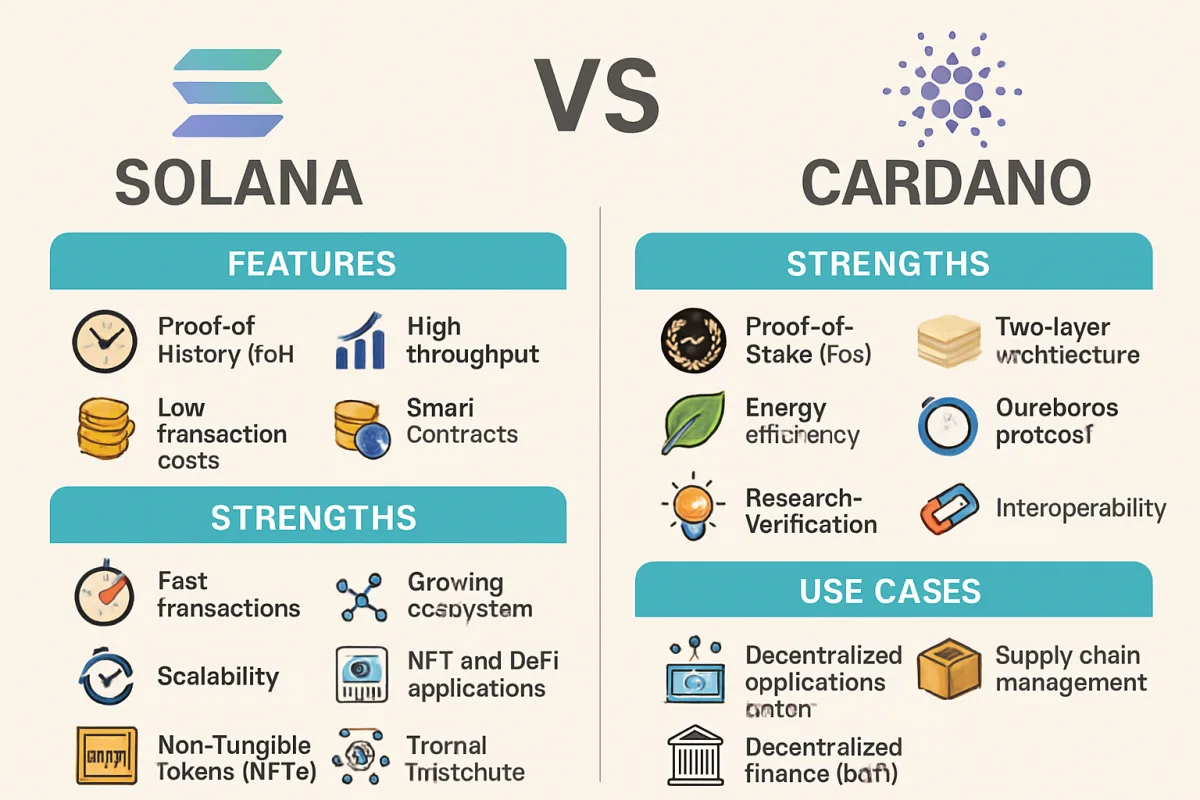
Solana and Cardano are two prominent blockchain platforms, each with unique features and use cases. Solana is known for its high throughput and low transaction costs, making it ideal for decentralized applications and DeFi projects. In contrast, Cardano emphasizes security and sustainability, utilizing a proof-of-stake consensus mechanism that appeals to developers focused on long-term scalability and governance. The choice between them largely depends on specific project needs, such as speed versus security.
Quick Summary
Choosing between Solana and Cardano involves understanding their core strengths. Solana excels in speed and cost-effectiveness, suitable for high-volume applications, while Cardano focuses on security and sustainable development, appealing to projects that prioritize governance and long-term viability. Each platform has its unique ecosystem and community support, influencing which might be the better fit for developers or investors.
Curator Notes
Solana has gained significant traction due to its ability to process thousands of transactions per second, which is a game changer for applications requiring high throughput. Its low transaction fees make it attractive for developers looking to build decentralized applications (dApps) and DeFi solutions without incurring hefty costs. However, the trade-off is that Solana's rapid growth has raised concerns about network stability and decentralization, as it relies on a smaller number of validators compared to other platforms.
On the other hand, Cardano takes a more measured approach, focusing on a research-driven development process. Its proof-of-stake consensus mechanism, Ouroboros, is designed to be energy-efficient and secure, making it a strong candidate for projects that prioritize sustainability. Cardano's emphasis on formal verification and peer-reviewed research can be appealing for developers looking for a robust framework, although this can result in slower feature rollouts compared to Solana.
Community support also plays a crucial role in the adoption of these platforms. Solana has built a vibrant ecosystem with numerous projects, including NFT marketplaces and DeFi protocols, which can provide a rich environment for developers. Conversely, Cardano's community is deeply invested in governance and long-term planning, which can foster a sense of stability and trust among its users.
When considering scalability, Solana's architecture allows for horizontal scaling, which can accommodate increased demand without sacrificing performance. However, this can lead to challenges in maintaining decentralization, as fewer nodes can lead to potential centralization risks. Cardano, while slower in transaction processing, aims for a more decentralized approach, which may appeal to users concerned about the implications of centralization.
In terms of developer experience, Solana offers a more straightforward onboarding process with extensive documentation and support. This can be a significant advantage for new developers looking to dive into blockchain development quickly. Cardano, while offering a rich set of tools, may require a steeper learning curve due to its complex architecture and focus on formal methods.
Ultimately, the decision between Solana and Cardano should align with the specific goals of the project. If speed and low costs are paramount, Solana may be the better choice. However, for projects that value security, sustainability, and community governance, Cardano presents a compelling option.
Understanding these nuances can help developers and investors make informed decisions in the rapidly evolving blockchain landscape.
Recommended Options
- Solana: Best for High-throughput applications and DeFi projects Offers fast transaction speeds and low fees, ideal for scaling applications. Signal checked: Strong growth in user adoption and a vibrant ecosystem of dApps. Alternative to consider: Ethereum for broader developer tools and community support.
- Cardano: Best for Projects prioritizing security and sustainability Research-driven approach with a focus on governance and formal verification. Signal checked: Growing community engagement and emphasis on long-term scalability. Alternative to consider: Polkadot for interoperability and cross-chain capabilities.
Best Sources
Videos and Community Signals
Solana isn't dead, but Cardano doesn't have the terrible reputation that $SOL does. What are you choosing? #cardano #solana ...
In this conversation, Peter discusses the critical importance of decentralisation in blockchain networks, particularly focusing on the ...
Comparison
| Decision Point | Good Starting Choice | When to Go Further |
|---|---|---|
| Transaction Speed | Cardano (slower but secure) | Solana (fast, suitable for high-volume applications) |
| Consensus Mechanism | Cardano (proof-of-stake, energy-efficient) | Solana (proof-of-history, high throughput) |
| Community Focus | Cardano (governance and sustainability) | Solana (innovation and rapid development) |
FAQ
Solana is generally preferred for NFTs due to its lower transaction fees and faster processing times.
Cardano's focus on formal verification and a robust consensus mechanism makes it a strong contender for security.
Yes, Cardano supports DeFi applications, but its ecosystem is less mature compared to Solana's.