Claude API vs OpenAI API Compared
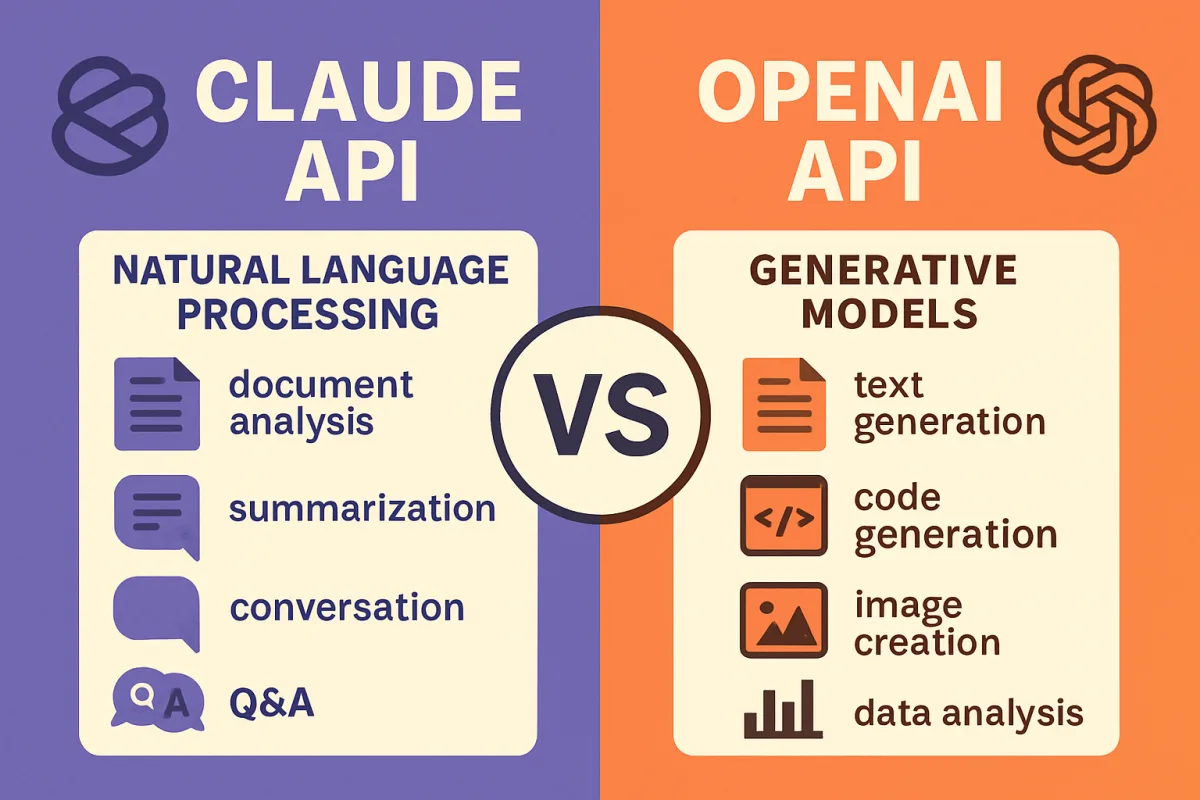
Claude API and OpenAI API are two prominent AI models offering distinct features and capabilities. Claude API, developed by Anthropic, focuses on safety and user alignment, making it suitable for applications requiring ethical considerations. In contrast, OpenAI API, known for its versatility and extensive training data, excels in a wide range of applications from chatbots to content generation. Choosing between them depends on your specific needs, such as ethical alignment versus broad functionality.
Quick Summary
This comparison explores Claude API and OpenAI API, highlighting their unique features, strengths, and suitable use cases. Claude API prioritizes safety and ethical considerations, while OpenAI API offers versatility for various applications. Understanding these differences can help you make an informed choice based on your project requirements.
Curator Notes
Claude API, created by Anthropic, is designed with a strong emphasis on safety and user alignment. It incorporates advanced safety measures to ensure that the AI behaves in a manner consistent with user intentions and ethical guidelines. This makes it particularly appealing for industries where ethical considerations are paramount, such as healthcare or finance.
Claude's architecture allows for nuanced interactions, making it suitable for applications that require a high degree of trust and reliability. On the other hand, OpenAI API is renowned for its versatility and extensive capabilities. It supports a wide array of applications, including chatbots, content generation, and data analysis.
OpenAI's model benefits from a vast training dataset, which enhances its ability to understand and generate human-like text across various contexts. This flexibility makes it an excellent choice for developers looking to implement AI in diverse scenarios, from creative writing to technical support. Ultimately, the choice between Claude API and OpenAI API hinges on your specific requirements.
If your project demands a strong ethical framework and user alignment, Claude may be the better option. Conversely, if you need a robust, multi-functional AI that can handle a variety of tasks, OpenAI API is likely the more suitable choice.
Recommended Options
- Anthropic Claude API: Best for Applications requiring ethical AI interactions Prioritizes safety and user alignment Signal checked: Positive reviews for ethical considerations in AI Alternative to consider: OpenAI API for broader functionality
- OpenAI API: Best for Versatile applications across various industries Extensive training data and flexibility Signal checked: Widely used in diverse applications with strong community support Alternative to consider: Claude API for safety-focused needs
Best Sources
Videos and Community Signals
Anthropic introduced a new feature that is surprisingly useful and today we look at when you should be using it over GPTs by ...
Stop guessing which AI to pay for. In this video I compare ChatGPT, Gemini, Claude and Perplexity side-by-side so you can ...
Comparison
| Decision Point | Good Starting Choice | When to Go Further |
|---|---|---|
| Ethical Alignment | OpenAI API offers general safety features. | Claude API provides advanced safety measures and user alignment. |
| Versatility | OpenAI API is suitable for a wide range of applications. | Claude API is more specialized for ethical applications. |
| User Trust | OpenAI API is trusted for general use. | Claude API is preferred in sensitive industries requiring high trust. |
FAQ
Claude API focuses on safety and ethical considerations, while OpenAI API offers broader functionality for various applications.
Claude API is recommended for applications that prioritize user alignment and ethical interactions.
Yes, OpenAI API is highly versatile and suitable for creative writing and content generation.